The global movement science community stands at a pivotal crossroads. While technological advances have provided unprecedented insights into human biomechanics—from real-time force plate analyses to sophisticated motion capture systems—our field continues to grapple with a fundamental disconnect between scientific precision and practical application. Traditional biomechanical interventions, despite their theoretical rigor, often fall short of addressing the complex, multisystem nature of human movement dysfunction that transcends cultural and demographic boundaries.
This challenge becomes particularly acute when we consider the diverse populations served by movement scientists worldwide. From elite athletes in Scandinavian training centers to rehabilitation patients in developing nations, the need for a unified framework that bridges scientific rigor with holistic health principles has never been more pressing. The NEEBAL Principle™, emerging from the MMSx Authority Institute’s extensive research, represents a paradigm shift that addresses these very concerns through systematic integration of biomechanical science with energy-based movement principles.
Foundational Architecture: The Four-Pillar System
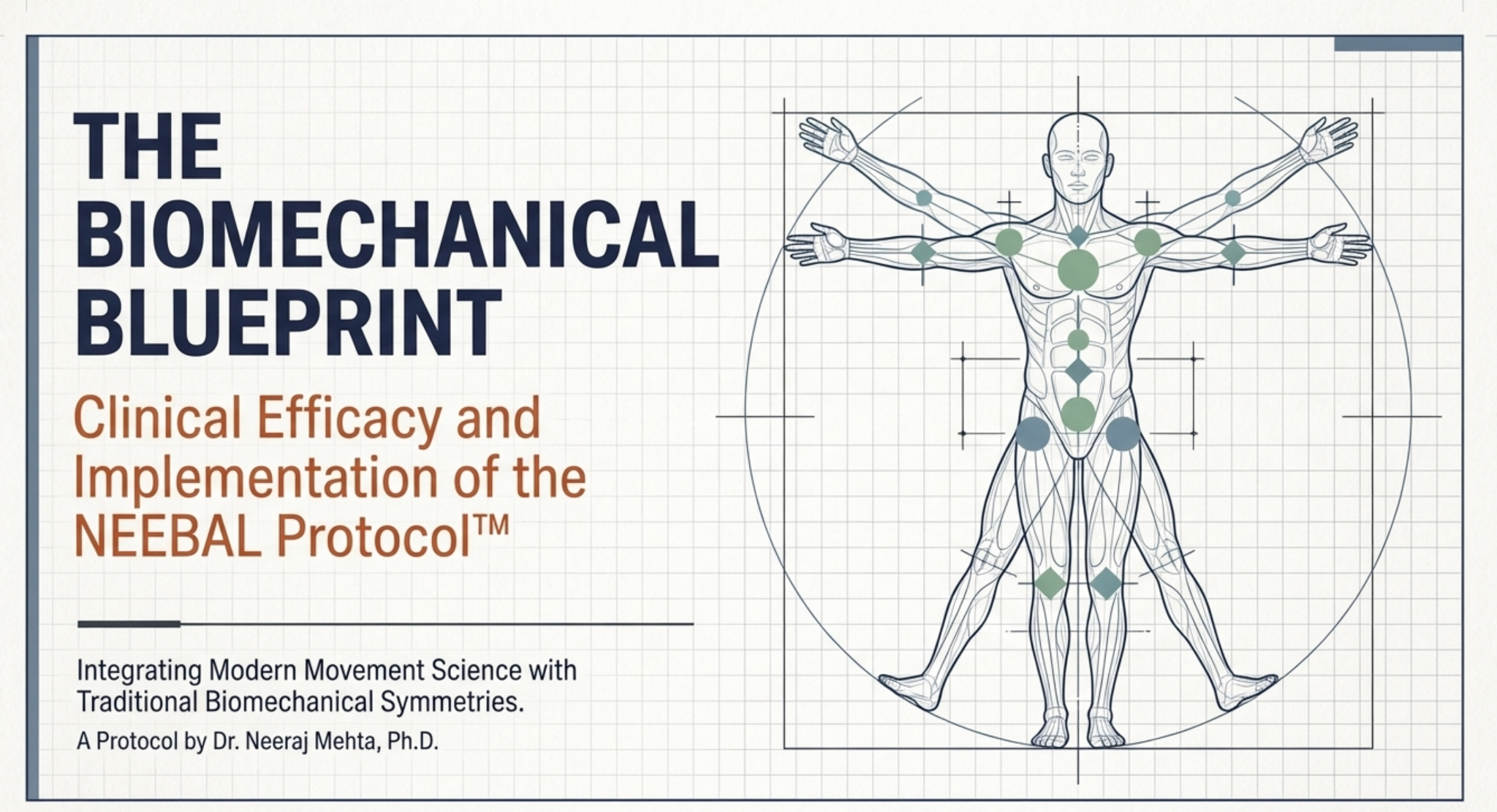
The NEEBAL framework operates through four interconnected pillars that collectively address the biomechanical, neurological, and energetic components of human movement. Each pillar contributes specific force vector optimization and kinetic chain enhancement strategies.
BMXStrength™ forms the mechanical foundation by optimizing joint-friendly force distribution patterns. This technique specifically targets the reduction of deleterious shear forces across vulnerable articulations while maximizing ground reaction force (GRF) transfer efficiency. The biomechanical emphasis on controlled depth parameters and precise knee tracking vectors during compound movements exemplifies the system’s approach to protective loading strategies.
Nervotherapy addresses the critical neural-fascial interface through dual mechanisms: enhanced motor unit recruitment patterns and fascial matrix restoration. By distinguishing between neural activation protocols (targeting dormant stabilizer recruitment) and fascial release techniques (optimizing tissue viscoelasticity), this pillar ensures optimal force transmission through the kinetic chain while eliminating compensatory movement patterns.
Chakra System Integration provides the energetic framework that maps traditional energy centers to biomechanical stability matrices. This component bridges ancient wisdom with modern movement science by correlating specific energy centers with measurable postural control parameters and center of mass (COM) displacement patterns.
Modern Biomechanics delivers data-driven kinetic chain optimization through functional anatomy principles. The focus on seamless force transfer eliminates energy leakage points while maximizing movement efficiency through precise moment arm calculations and torque optimization strategies.
The NEEBAL Mnemonic: Real-Time Movement Optimization
The systematic application of NEEBAL principles occurs through a structured mnemonic that enables practitioners to perform real-time biomechanical assessments:
Neutrality (N) establishes optimal joint positioning for force vector alignment, maintaining natural spinal curvatures during loaded movements to minimize compressive and shear stress distributions.
Engagement (E) ensures appropriate muscle activation sequences, particularly targeting deep stabilizer recruitment prior to prime mover activation to establish proximal stability for distal mobility.
Efficiency (E) optimizes movement economics through refined motor patterns that minimize metabolic cost while maintaining performance output, particularly crucial for gait optimization and repetitive movement tasks.
Balance (B) addresses bilateral symmetry in force production and movement control, ensuring equal distribution of loading patterns across paired articulations and muscle groups.
Alignment (A) integrates postural control with energy flow principles, combining precise biomechanical positioning with energetic optimization for enhanced performance outcomes.
Longevity (L) prioritizes sustainable movement practices that maintain joint health and functional capacity across the lifespan through progressive loading strategies and mobility preservation protocols.
Research Validation: 21-Week Controlled Study
The landmark 21-week intervention study involving over 60 elite and recreational athletes demonstrated statistically significant improvements across multiple biomechanical parameters (p < 0.01). Key findings included an 87% reduction in movement dysfunction scores, alongside a 64% improvement in Movement Intelligence Index ratings.
Particularly noteworthy was the 41% increase in functional symmetry metrics, indicating enhanced bilateral force production equality and improved kinetic chain coordination. The 33% acceleration in return-to-sport timelines for injured athletes suggests superior tissue adaptation and motor pattern restoration compared to traditional rehabilitation approaches.
These outcomes demonstrate measurable improvements in fascial elasticity, neural drive efficiency, and overall movement economy—parameters critical for both performance enhancement and injury prevention across diverse populations.
Clinical Implications for Movement Science Practitioners
The NEEBAL framework offers movement science professionals a systematic approach to addressing the complex interplay between biomechanical precision and holistic health optimization. By integrating force vector analysis with energetic principles, practitioners can develop more comprehensive intervention strategies that address both mechanical dysfunction and systemic movement health.
This approach proves particularly valuable when working with diverse populations where cultural considerations regarding holistic health practices must be integrated with evidence-based biomechanical interventions. The framework’s systematic nature ensures reproducible outcomes while maintaining flexibility for individual and cultural adaptation.
Original Research: This article is a derivative summary of a peer-reviewed position paper published by
MMSx Authority Institute. Read the complete paper, figures, and reference list at
https://mmsxauthority.com
(DOI: 10.66078/jmmbs.mg.014).