
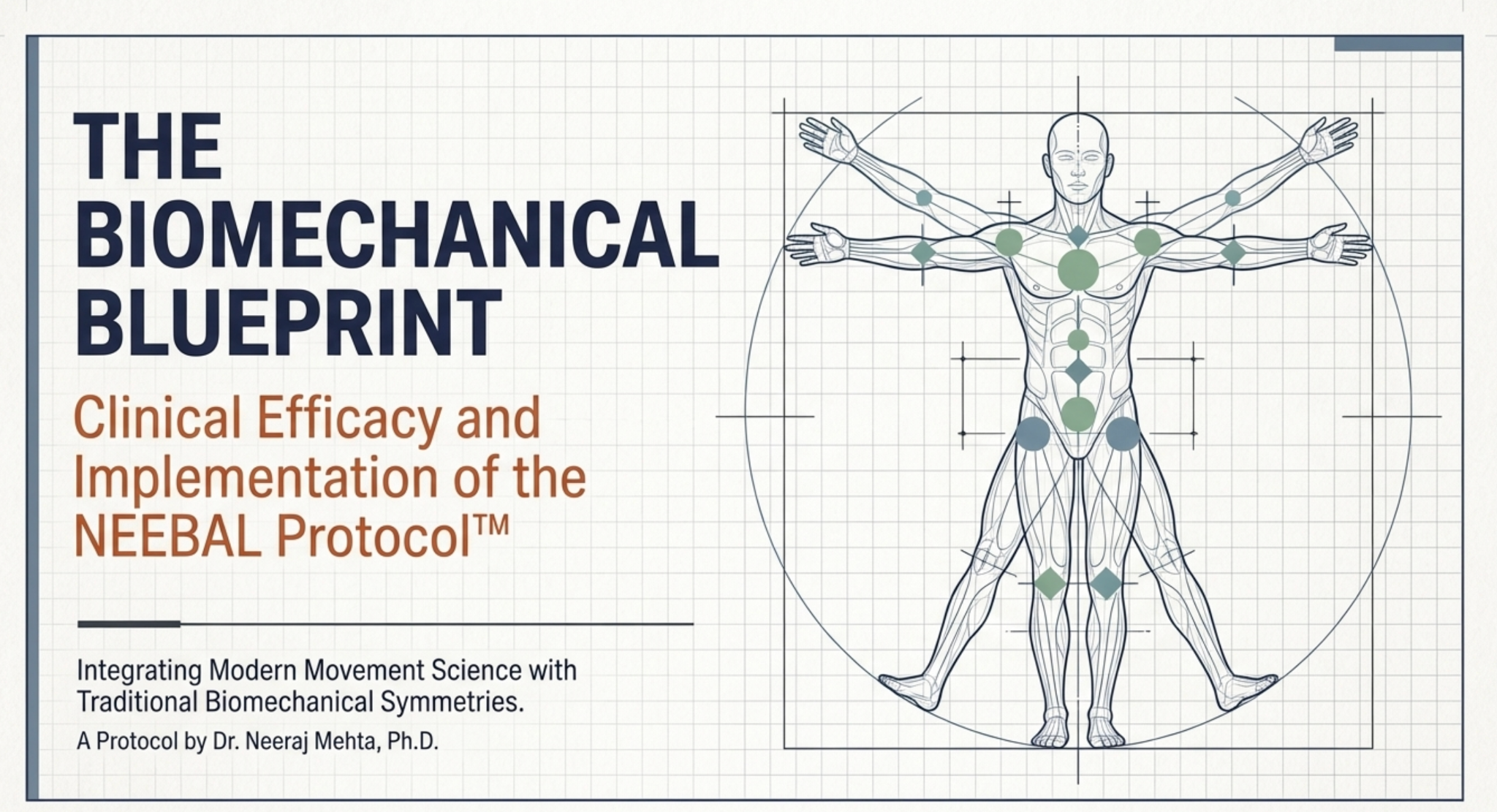
Movement science stands at a transformative crossroads. As we witness the global rise of movement-related dysfunctions—from tech neck to athletic overuse injuries—the international research community faces an unprecedented challenge: How do we bridge the gap between reductionist biomechanical models and the complex, interconnected reality of human movement? The answer may lie in a revolutionary framework that challenges our fundamental assumptions about force transmission, neural control, and energy efficiency.
The NEEBAL Principle™, emerging from the MMSx Authority Institute, represents a paradigm shift in movement mechanics research. This framework synthesizes rigorous biomechanical analysis with energy system integration, offering our global research community a methodology that addresses the multidimensional nature of human movement. For movement scientists worldwide, this approach provides quantifiable metrics for assessing not just mechanical efficiency, but the holistic integration of fascial health, neural activation patterns, and energetic alignment within the kinetic chain.
Biomechanical Foundation: The Four-Pillar Architecture
The NEEBAL framework is constructed upon four distinct yet interconnected pillars, each addressing specific aspects of movement optimization through measurable biomechanical parameters.
BMXStrength™ focuses on joint-conserving force distribution patterns. This methodology emphasizes optimizing moment arms while minimizing shear forces across vulnerable joint complexes. Through careful analysis of ground reaction forces (GRF) and their translation through the kinetic chain, practitioners achieve strength gains while preserving joint integrity. The biomechanical principle centers on distributing load vectors evenly, preventing compensatory patterns that lead to tissue breakdown.
Nervotherapy addresses the critical interface between neural drive and fascial responsiveness. This pillar distinguishes between motor unit recruitment optimization and fascial elasticity enhancement. Research demonstrates that neural activation patterns directly influence force vector efficiency, while fascial health determines the mechanical properties of force transmission. By quantifying changes in electromyographic patterns alongside fascial tension measurements, this component provides objective metrics for neuromuscular optimization.
Chakra System Integration maps traditional energy centers to measurable postural and stability parameters. This component translates ancient energy concepts into biomechanically relevant stability indices, center of mass (COM) control, and proprioceptive feedback mechanisms. Research validates that specific grounding movements correlate with measurable improvements in postural stability and force platform metrics.
Modern Biomechanics employs kinetic chain analysis to eliminate energy dissipation throughout movement patterns. By analyzing force vectors, joint angular velocities, and torque production across multiple segments simultaneously, this pillar identifies and corrects mechanical inefficiencies that compromise performance and increase injury risk.
The NEEBAL Mnemonic: Systematic Movement Assessment
The acronym serves as a comprehensive assessment framework for movement quality:
Neutrality (N): Maintaining optimal joint alignment to minimize stress concentrations and maximize force transmission efficiency.
Engagement (E): Activating appropriate muscle groups in proper sequence to create stable force platforms for movement initiation.
Efficiency (E): Optimizing energy transfer through the kinetic chain while minimizing compensatory movement patterns.
Balance (B): Achieving bilateral symmetry in force production, range of motion, and neuromuscular control.
Alignment (A): Integrating postural integrity with energy flow patterns for optimal biomechanical function.
Longevity (L): Implementing sustainable movement strategies that preserve tissue health across the lifespan.
Research Validation: Quantifying Holistic Movement Integration
The landmark 21-week intervention study involving 60+ athletes provides compelling evidence for the NEEBAL framework’s efficacy. Key biomechanical findings include:
- 87% reduction in movement dysfunction scores, measured through standardized functional movement screens
- 64% improvement in Movement Intelligence Index, a composite measure of coordination, efficiency, and adaptability
- 41% enhancement in functional symmetry metrics, assessed through bilateral force platform analysis
- 33% acceleration in return-to-sport timelines, indicating improved tissue healing and movement competency restoration
These results demonstrate statistically significant improvements (p < 0.01) across multiple biomechanical parameters, validating the framework's capacity to enhance movement quality through integrated assessment and intervention strategies.
Implications for Global Movement Science Practice
For the international movement science community, the NEEBAL Principle™ offers a standardized methodology for assessing and improving human movement that transcends cultural and methodological boundaries. This framework provides objective biomechanical metrics while acknowledging the complex, interconnected nature of movement system function.
The integration of traditional energy concepts with modern biomechanical analysis opens new avenues for cross-cultural research collaboration, potentially bridging Western scientific methodology with Eastern movement philosophies. This approach may prove particularly valuable in developing culturally sensitive movement interventions for diverse global populations.
Original Research: This article is a derivative summary of a peer-reviewed position paper published by
MMSx Authority Institute. Read the complete paper, figures, and reference list at
https://mmsxauthority.com
(DOI: 10.66078/jmmbs.mg.014).